

Why you should respond to that LinkedIn InMail
LinkedIn's new AI-agent solution called Hiring Assistant is taking on sourcing, evaluation and engagement work for some recruiters.
I’m sure you’ve seen the headlines about AI-doctored job applications flooding job postings and making every applicant look like the perfect fit. But the real AI-driven disruption happening on the recruiting side is disconcertingly flying below the radar.
In this part of the series, I’ll walk you through what the disruption looks like, why you should care, and what to do now.
I’ll focus on LinkedIn specifically as this is the platform where much of the executive recruitment process happens.

In a nutshell:
Late last year LinkedIn rolled out a new solution for hiring managers and recruiters called Hiring Assistant
Instead of recruiters searching via keywords, filters and boolean search, they can now chat with the Hiring Assistant about what they are looking for.
From there, LinkedIn’s team of AI agents crawl (i.e. search) through LinkedIn to find matches and present a list of candidates to the recruiter.
The AI agents also package the candidates to the recruiter: explaining why they may be a fit for the role.
All of this can be done without a public job posting and without a human needing to scan through profiles.
How does it all work?
These AI agents leverage data from LinkedIn’s Economic Graph, which is in their words “a digital representation of the global economy” based on over 1.2 Billion members and 69 million companies worldwide. Most importantly, they’ve learned which concoction of the 41 thousand skills (found across LinkedIn and within their Skills Graph) fuel certain career paths, which skills make a candidate a perfect fit for a role, and which do not. In addition to skills, the AI agents have a wealth of other indicators and signals that they are working through across profiles.
“Tapping into EG [Economic Graph] and LinkedIn Talent Insights gives the agent a deep understanding of talent supply, demand, and movement. This enables advanced sourcing strategies, such as identifying top locations, titles, and skills for a given talent pool, spotting active or recently hired candidates, and uncovering talent flows where the recruiter's company is winning or losing.” —LinkedIn’s Engineering Blog
There’s a lot of upside here for both candidates and recruiters:
It bypasses the AI-slop hiring professionals have been battling with AI-optimized job applications. It’s harder to engineer a profile to simultaneously present as a perfect fit for a variety of roles.
Not only does it save time for recruiters, but it can potentially cast a wider net since the AI agent team ”runs sourcing and evaluation jobs across millions of profiles […] refreshes candidate pipelines daily and evaluates new applicants continuously.” —LinkedIn’s Engineering Blog.
Because of the years of learning from the aggregate data within LinkedIn’s Economic graph, Hiring Assistant may propose candidates that would not have otherwise been discovered by the recruiter.
But there are also some things that they have published that have given me pause:
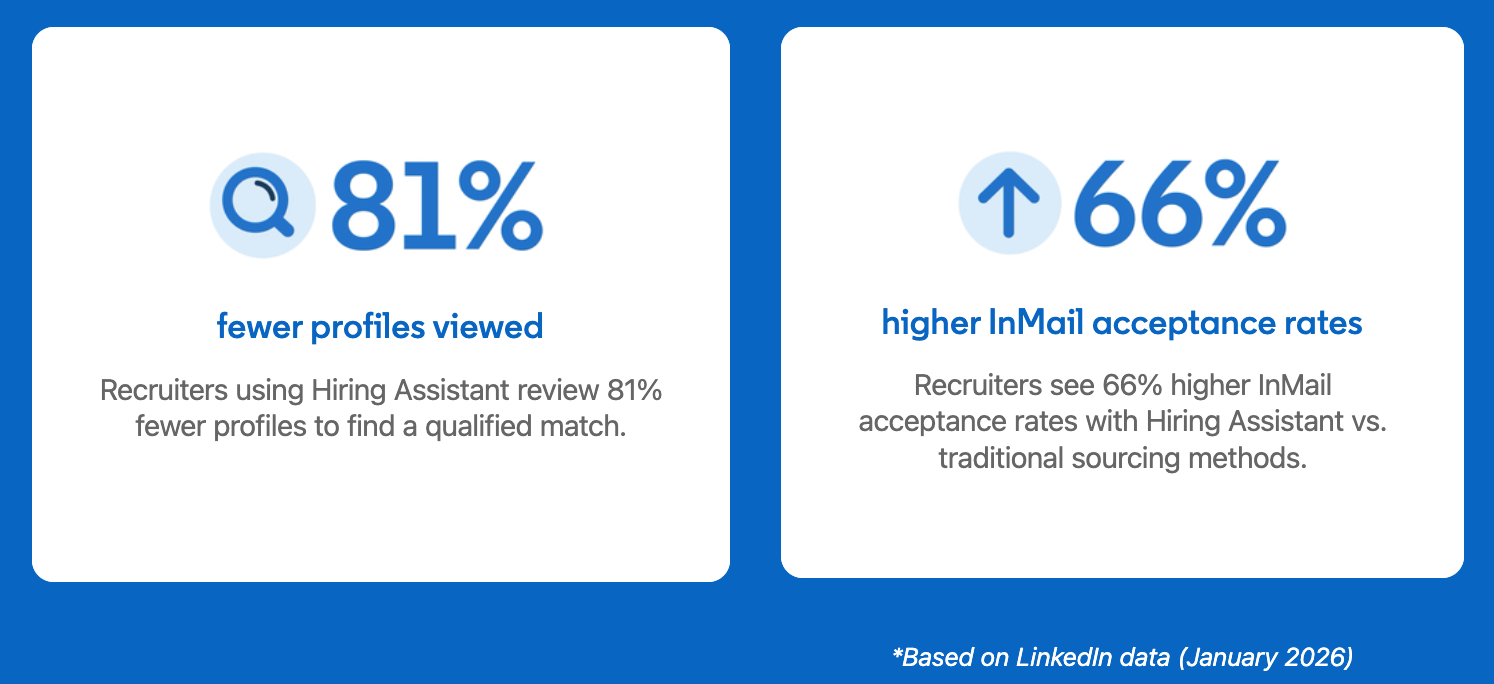
In many of their sales materials, LinkedIn promotes the fact that “recruiters using Hiring Assistant review 81% fewer profiles to find a qualified match.” That’s a significant drop, dramatically lowering how many profiles the human in the loop is actually looking through in order to hone their expertise as a recruiter. This is a big shift in the sourcing process—one with unknown long term implications.
A 66% higher InMail acceptance rate is a BIG number. How is this happening? I’m sure there are many reasons for this increase but it makes me worry about the following:
Are AI agents up-ranking candidates who are super-users of the platform, i.e. those signalling to the platform that they have a quicker response time or higher acceptance rate to InMail?
And, on the flip side, are AI agents also down-ranking those that have been recently hired (i.e. less likely to respond to an InMail)?
Their Engineering Blog (as quoted above) frequently mentions how the AI agent team is excellent at “spotting active or recently hired candidates”.
How many InMail requests have you ignored over the years and what kind of signal is that sending to the AI team?
WHAT TO DO NOW
My recommendation: Make sure your settings for “open to work” are privately turned on, as there are theories around how this affects how AI interprets your willingness to respond to an InMail. Speaking of which, next time you receive an InMail that is completely out of left field or for something way too junior. RESPOND ASAP within 24hrs with a polite “No thanks”. The goal is to minimize any negative profile signal like “inactivity”.
I’ve taught workshops on what this new AI-era hiring process means for women and have worked with executives to optimize their reputation architecture online.
And now, here on Power Stack, I’ll tell you everything I know, from the hours I spent poring through LinkedIn’s engineering papers and sales materials. I’ll also lay out a step by step guide on how to optimize what I call AI-Era Reputation Architecture. If you, like me, are too impatient to wait for each article, you can dive in to everything via our Reputation Architecture eBook download bundle.